
Dentist Anna Marktorp answers questions about why she almost exclusively performs all dental care using a rubber dam

What is a rubber dam?

A rubber dam is a rectangular elastic cloth that is used in dentistry, traditionally for root canal treatment, but also when performing adhesive dentistry. The main function is to isolate the treated tooth from oral saliva and bacteria during treatment. The cloth (rubber dam) is attached with a holder around the teeth to be treated and remains in place during the entire treatment. After the treatment, the cloth is easily removed.

What are the biggest advantages of using a rubber dam?

I think rubber dam insulation has great advantages for both patient and dentist, but also significantly increases the quality of the work performed. For example, the patient avoids rinsing water flowing to the back of the throat, and many describe the feeling “as if the dental care is taking place outside the mouth”. As a dentist, I get an accessible dry and aseptic (bacteria-free) work area. In adhesive dentistry, such as filling therapy and cementation of crowns, a dry environment can be ensured and thus a better result can be achieved. The risk of the patient getting something down the throat is also minimized by using a rubber dam.

Why don't you think all dentists work with rubber dams?

Ignorance that rubber dams can be used for more than root canal treatment is, I think, one of the most common reasons. It can feel technically complicated because it is hardly taught in dental school, thus I think many dentists feel that it takes a long time and is difficult initially. The fact is that with the right technique, it makes things a lot easier for me as a dentist, but also for the patient as it prevents amalgam residue from entering the back of the throat, as well as some of the substances that we use treat the teeth with (which usually do not have an appreciated taste by the patients ..)

In what way has using a rubber dam changed your everyday life at the clinic?

Personally, I love working with a rubber dam! I see details that cannot be seen without isolating the area with a rubber dam. The work thus becomes much more accurate. A rubber dam gives me full control over the teeth I treat and less stress by gently keeping saliva and mucous membranes out of the way.

What advice would you like to give to dentists who currently do not have much experience with rubber dams?

Take a course in the subject – I did! Ask dentists who work with rubber dams about what to keep in mind! The community on Instagram is fantastic.
Search for: #rubberdam #rubberdamfam #rubberdamology

Practice, practice, practice!
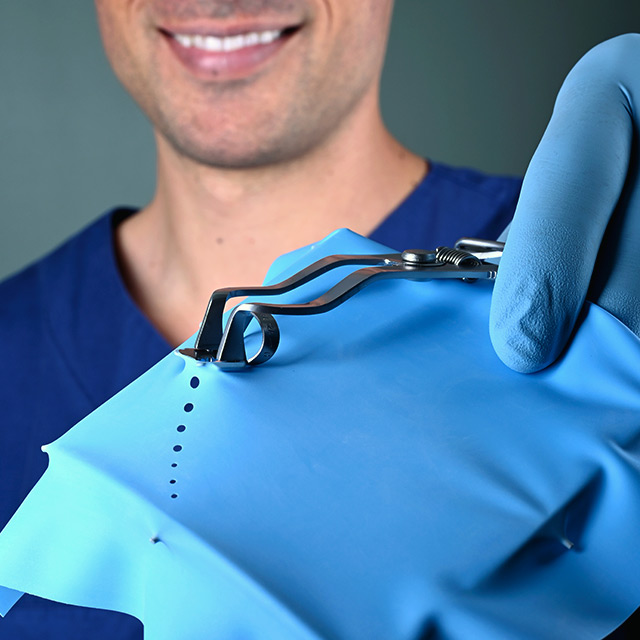
Milos shows how working with a rubber dam is done.
Rubber dam

If you have questions or concerns about rubber dams, both patients and dentists are welcome to email them to: info@ltg.nu

Photo of Dentist Anna Marktorp answering questions about using a rubber dam in connection with dental treatments.
Dentist Anna Marktorp

Share this page